Saint imagery is among the oldest visual forms in European art history. For centuries, images of saints accompanied people in prayer and daily life, in moments of hope and decision. Their visual language was always bound to its time – and changed with it.
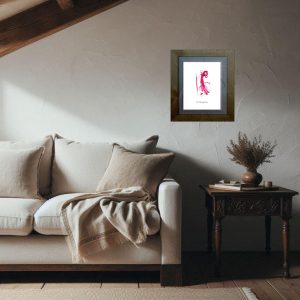
Contemporary images of saints are artistic works that translate figures of the Christian tradition into a visual language for today and are conceived for modern spaces.
This question therefore arises anew:
How can contemporary images of saints resonate within contemporary interiors?
For several years, Ulrike Rainer has been developing an independent visual language in her Vienna-based Atelier Wonnereich. Her saint paintings are neither historical quotations nor reproductions, but contemporary artistic positions that emerge from tradition while remaining firmly rooted in the present.
You can find a selection of contemporary Christian works of art from Atelier Wonnereich at Selected Works.
Saints as an Expression of Inner Attitude
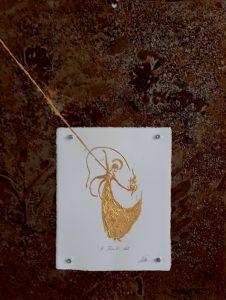
The figures depicted in these images of saints sometimes appear calm and almost static, at other times dynamic – extending to the motifs of the Holy Dancers cycle. Movement and stillness coexist on equal terms.
The saints in these figurative paintings stand for something timeless: integrity, steadiness, composure, courage – as well as creativity, vitality and empathy. They appear as seekers of light, as warriors in the struggle against darkness, as builders of fortresses, as wanderers in the desert.
These works invite not only theological contemplation, but a quiet encounter with individuals who achieved something lasting.
You can find out more about the artist and the creation of these works on the page About Atelier Wonnereich.
Material as a Carrier of Meaning
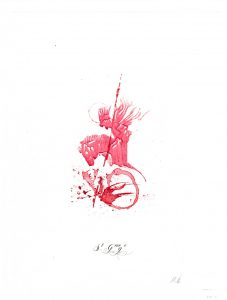
All paintings by Ulrike Rainer are created by hand on high-quality handmade paper. Genuine 23-carat gold leaf and red document ink trace figures, symbols or gestures onto the surface.

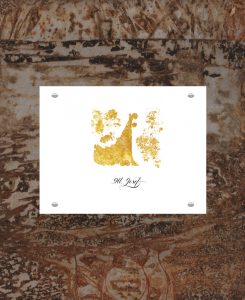
Gold is not used as ornament. In these paintings, it functions as a carrier of light: as a calm surface, a fine line, or a vigorous brushstroke that changes with space, daylight and perspective. It stands for openness and transcendence, without asserting itself.
The red ink is equally deliberate. Within Ulrike Rainer’s visual language, it signifies martyrdom – men and women who accepted death for the sake of inner conviction. Red does not mark drama here, but the consequence of a stance.
Some works are mounted on iron plates that are deliberately rusted under controlled conditions in the atelier. These plates do not function as conventional frames; they extend the image into space. They create a conscious contrast between colours, forms and materials – and between different realms: iron as a sign of the earth, gold as a reference to the heavens, ink as the expression of the human being in between.
Christian Art for Today’s Spaces
Ulrike Rainer’s contemporary images of saints are conceived for present-day living and working environments. Their visual language is timeless, allowing the works to integrate into a wide range of contexts.
These saint paintings are equally at home in clear urban apartments and rustic interiors, in old farmhouses and restrained student flats, in alpine chalets as well as elegant seaside apartments. They find their place in modern and classical spaces alike: homes, studios, offices, practices and hotels. They do not compete with their surroundings; they stabilise them.
They are present without being loud.
Between Tradition and the Present
The saints depicted in these works stem from the Christian tradition: Catherine of Alexandria, Elisabeth of Thuringia, Joan of Arc, Christopher and George, angels and archangels, figures of martyrdom. Their stories form part of Europe’s cultural memory.
In Ulrike Rainer’s images of saints, these figures are not historicised. They are released from time-bound representational forms and translated into a timeless, contemporary presence. This creates a field of tension between tradition and present-day perception.
The images do not always prescribe an interpretation. They leave space.
An Art of Reduction
The visual language of Atelier Wonnereich is shaped by deliberate reduction. Lines may be forceful or delicate, always serving expression rather than ornament. Surfaces remain open. What is essential comes to the fore.
This reduction is not a loss, but a conscious decision. It allows these paintings to resonate beyond explicitly religious contexts – as signs of calm, focus and inner order.
Many owners report that the works gain significance over time. Not through explanation, but through presence.
For Those with a Sense for Depth
The works from Atelier Wonnereich address people who understand art as part of their lived environment. People who value materiality, stillness and meaning – independent of confession, yet open to spiritual dimensions.
The images are not answers. They are offerings.
Atelier Wonnereich – Ulrike Rainer
Ulrike Rainer is the founder and artistic director of Atelier Wonnereich in Vienna. All works are created by hand, either as unique pieces or as strictly limited series of selected motifs that nevertheless retain a unique character. In addition to existing works, she also realises bespoke commissions, upon request with a specific saintly reference.
Atelier Wonnereich stands for a contemporary form of Christian art: calm, reduced, present – and committed to tradition without repeating it.